The player window could not open. Open the music player in a tab.
Russian cases without panic
One Russian name can appear as Анна, Анну, Анны, Анне or Анной. The person has not changed. The form changes because the word has a different role in the sentence.
Падежи
Examples
Cases are not endings — they are roles
In English, word order often tells us who is doing the action and who receives it.
Anna sees Ivan.
Ivan sees Anna.
Change the order, and the meaning changes. In Russian, endings help show the role of each word, so word order can be more flexible.
The main idea is simple: a case shows what job a word has in the sentence. Is this person doing the action, receiving it, owning something, getting something, being with someone, or being discussed?
The main logic: role, not chaos
A large table of endings is not the best place to start. First identify the role of the word in the sentence. Each case is tied to a few recurring functions.
The person or thing doing the action.
The person or thing affected by the action.
Words like у, нет, с, о, в, на often signal a case.
The ending changes to match the word's role.
The six Russian cases
Russian has six cases. You do not need to master all endings at once. First, understand the job of each case.
Nominative
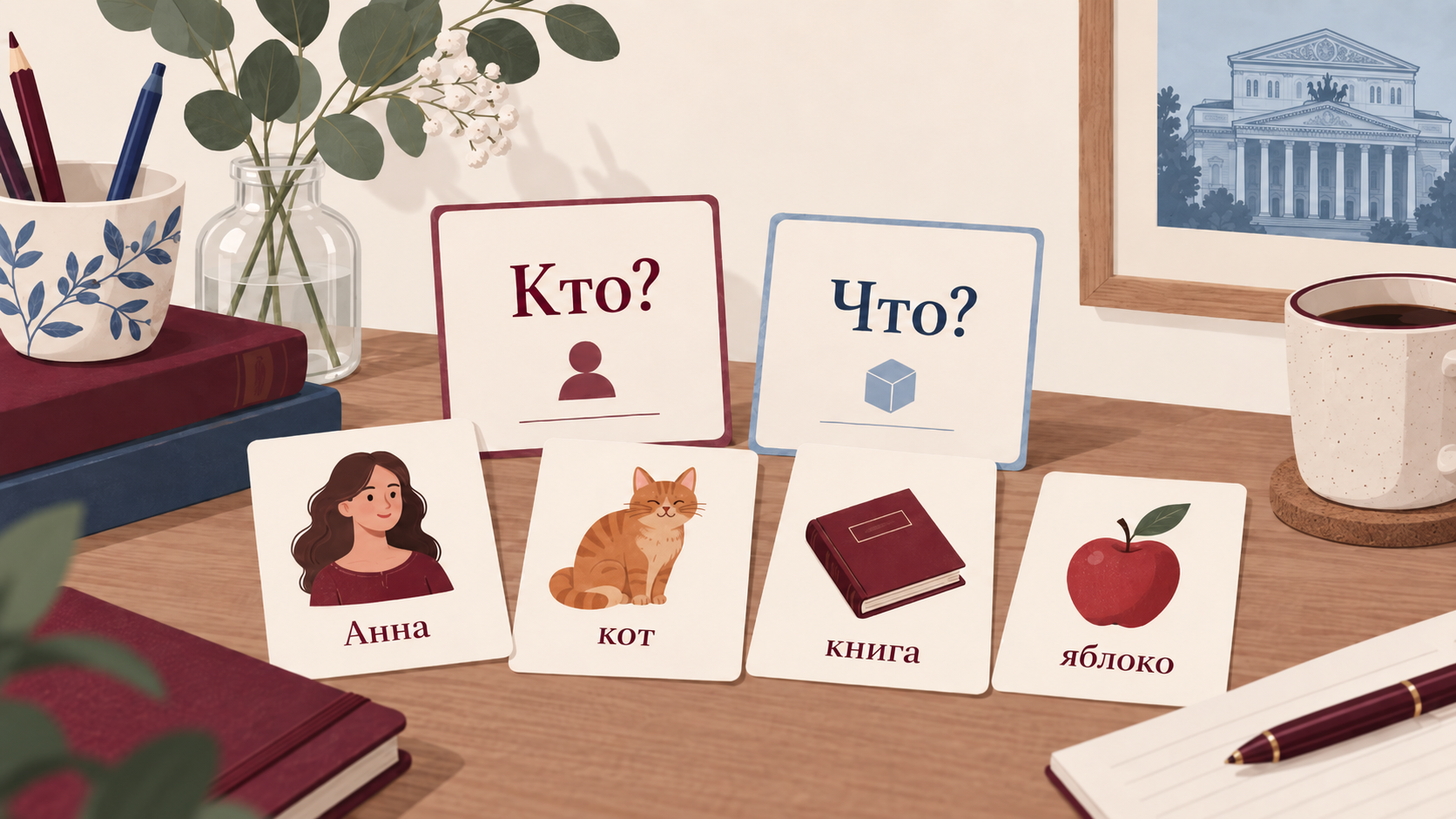
Именительный падежWho? What?The subject. The basic dictionary form.
Анна читает.
Accusative
Винительный падежWhom? What?The direct object. Someone or something receives the action.
Я вижу Анну.
Genitive
Родительный падежWhose? Of what?Absence, possession, quantity. Very common after у and нет.
У Анны есть книга.
Dative
Дательный падежTo whom? For whom?The receiver. Also used in patterns like мне нравится.
Я даю Анне книгу.
Instrumental
Творительный падежWith whom? With what?Company, tool, role. Often after с.
Я говорю с Анной.
Prepositional
Предложный падежAbout whom? Where?Topic or location. Used only with prepositions.
Я думаю об Анне.
One name, six roles
Take one name: Анна. The person stays the same; the form changes with her role in the sentence.
Anna acts
I see Anna
Anna has
to Anna
by / with
location/topic
| Situation | Russian | What happens |
|---|---|---|
| Anna is the subject | Анна читает. | Anna is doing the action. |
| I see Anna | Я вижу Анну. | Anna receives the action. |
| Anna has something | У Анны есть книга. | Russian uses genitive after у. |
| I give something to Anna | Я даю Анне книгу. | Anna receives something. |
| I speak with Anna | Я говорю с Анной. | “With” uses instrumental. |
| I think about Anna | Я думаю об Анне. | “About” uses prepositional. |
Useful beginner patterns
Cases become easier when you learn them inside phrases, not as isolated endings. Start with these blocks.
у + genitive
у + родительныйhavingУ меня есть вопрос.
I have a question.
нет + genitive
нет + родительныйabsenceУ меня нет времени.
I don’t have time.
dative pattern
дательный паттернexperienceМне нравится русский.
I like Russian.
с + instrumental
с + творительныйwithЯ говорю с другом.
I speak with a friend.
о / об + prepositional
о / об + предложныйaboutЯ думаю о работе.
I think about work.
в / на + prepositional
в / на + предложныйlocationЯ живу в городе.
I live in the city.
A practical way to identify the case
When you read a Russian sentence, identify the action and the roles before you check the ending.
What is happening in the sentence?
Who acts? Who receives? Who has? Who is with whom?
Look for words like у, нет, с, о, в, на.
Check which ending matches that case and noun pattern.
Example: Я говорю с другом.
Who is doing the action? Я.
With whom? с другом — instrumental.
Mini trainer: choose the role
Click the cards to check the role, then answer the short quiz.
Tap a card to reveal why the word changes.
Choose which case explains the highlighted word.
First endings: learn in small groups
Endings matter, but they are easier when you learn one noun type at a time. Here are three beginner-friendly models.
Do not try to memorise every Russian ending in one evening. Start with phrases you actually use: у меня есть, у меня нет, мне нравится, я говорю с, я живу в.
Common beginner mistakes
01. Trying to learn all endings first
Starting with a giant table of endings makes the system harder to understand.
Start with the role
Endings make more sense after you understand what the word is doing in the sentence. Begin with simple patterns.
02. Translating prepositions one by one
English and Russian prepositions do not always match perfectly.
Learn useful phrases as whole blocks
мне нравится, у меня есть, я говорю с.
03. Expecting English word order to save you
Russian word order can be flexible, so position alone does not always show the role.
Use the endings to identify the roles
Мама любит сына and Сына любит мама can keep the same meaning because the endings show the roles.
What to remember
Use this as a quick checklist after you finish the article.
Before you think about an ending, identify what the word is doing in the sentence.
Patterns such as у меня есть, у меня нет, мне нравится, я говорю с and я живу в are easier to reuse than isolated endings.
Анна, Анну, Анны, Анне and Анной can all refer to the same person. The form changes with the role.
Work with one noun pattern at a time instead of trying to memorise every ending at once.
Visual guide
A visual summary of the six cases, one name in six roles and the beginner patterns used in this article. You can also save it on Pinterest.
Russian cases without panic
Pin this infographic as a quick reference for Russian cases. It leads back to the full article with explanations, examples and practice.
What to learn next
Continue with this closely related topic.
In a free 30-minute trial, we can look at the case patterns you already know and decide what to practise next.