Начальная форма: the base form of the noun
Russian nouns change form depending on their role in a sentence. The nominative is the form you normally learn first. In Russian, this is the noun’s начальная форма — its base form — and it is usually the form you see in a dictionary.
Flip the cards to see how the nominative works as a word’s “starting form”.
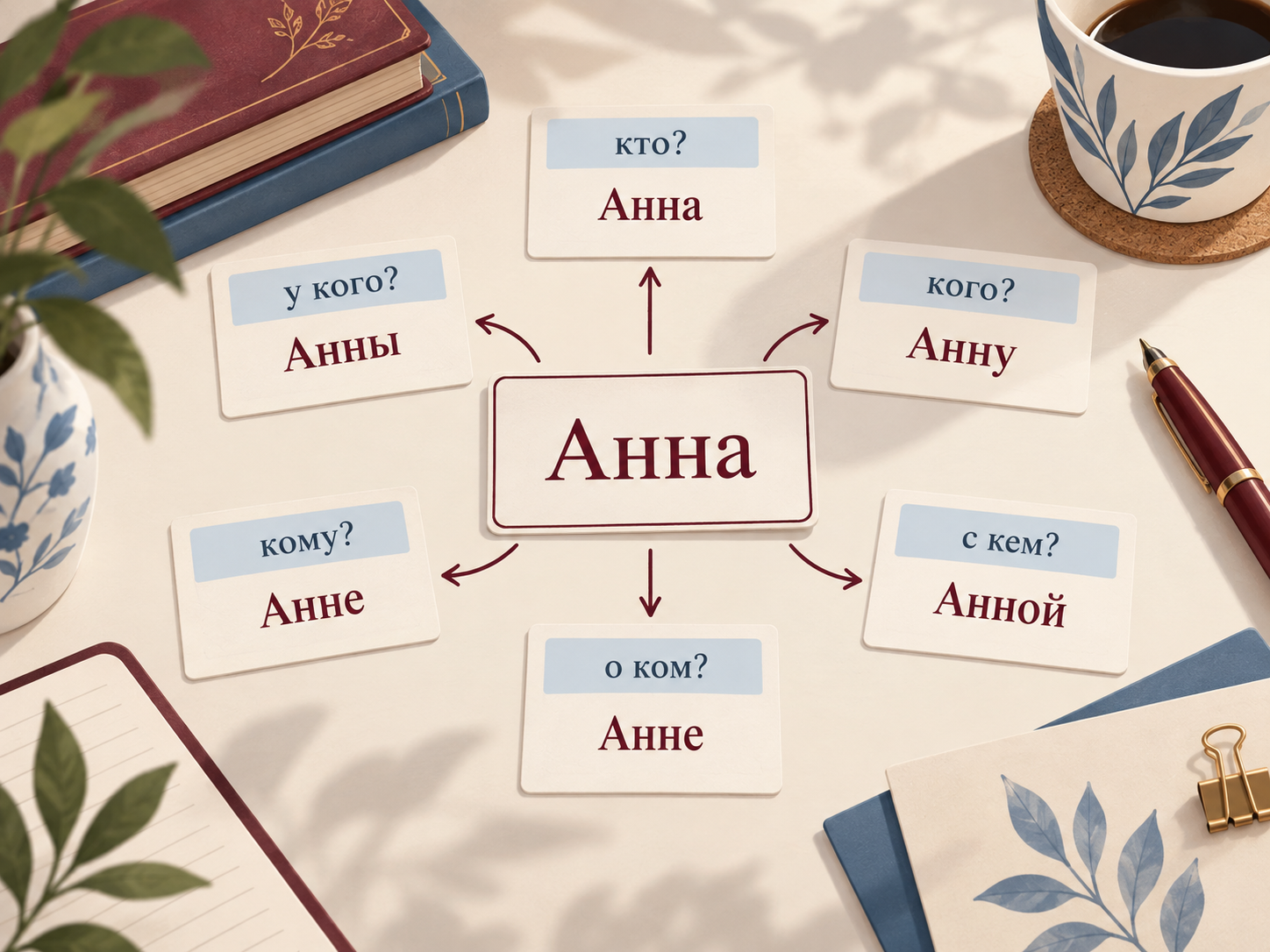
This is the base form. Later you may meet forms such as Анну, Анне and Анной.
This is the form that names the object. Other sentence roles can produce книгу, книге or книгой.
A masculine noun with no visible ending. This is its nominative singular form.
A typical neuter noun in -о. Here it simply names the thing.
The nominative is the form used to name a person or thing before another grammatical role changes the noun ending.
When do you use the nominative?
At beginner level, three uses matter most.
Анна is doing the action. The subject is nominative.
Книга tells you what the object is.
In a present-tense sentence, инженер identifies Mark’s profession.
Кто? is used for people and animals; Что? for things, places and ideas.
This pattern applies to basic present-tense identification. Many past-tense constructions use a different case.
Find the subject
The subject is the person or thing the sentence is about. In these examples, it is in the nominative case.
Which part is the subject?
Кто? or Что?
Use Кто? for people and animals. Use Что? for things, places and ideas. Choose a question for every word.
What does nominative look like?
The nominative does not have one special ending. Its form depends on gender and number. These are useful beginner patterns, not a complete dictionary of every noun ending.
музей
неделя
море
книги
The adjective must agree with the noun. That means gender and number are visible in the adjective ending too.
Make the words agree
Choose the adjective that matches the noun in the nominative case.
Это + nominative
One of the first Russian patterns you learn is Это… — “This is…” / “That is…”. The word or phrase that names what something is appears in the nominative.
This is my brother.
This is a new book.
This is a big university.
This is Moscow.
Spot the nominative form
Mini nominative quiz
Check whether you can recognise the case before moving on to the other Russian cases.
Question 1
Common beginner mistakes
01. Treating nominative as “the subject case only”
The nominative also names or identifies someone or something.
Remember the present-tense naming patterns
Это книга. and Марк — инженер. also use the nominative.
02. Looking for one special nominative ending
There is no single ending that marks every nominative noun.
Check gender and number
The form depends on the noun pattern: студент, книга, окно, студенты.
03. Changing the noun but not the adjective
Adjectives also show gender and number in the nominative.
Make the whole phrase agree
новый студент, новая книга, новое окно, новые студенты.
04. Using this present-tense rule for every form of “to be”
The article’s basic identification pattern is not universal.
Keep the rule inside its context
Here we are focusing on the beginner present-tense pattern; many past-tense constructions use a different case.
What to remember
Use this as a quick checklist after you finish the article.
Именительный падеж is the noun’s начальная форма — its base form.
Use Кто? for people and animals and Что? for things, places and ideas.
The nominative is used for the subject and in beginner identification patterns such as Это книга. and Марк — инженер.
Gender and number are visible in the adjective too: новый студент, новая книга, новое окно, новые студенты.
What to learn next
Continue with this closely related topic.
Practise your own grammar and speaking in a lesson.