The player window could not open. Open the music player in a tab.
Идти or ходить? A practical guide to Russian verbs of motion
Russian uses different motion verbs depending on the route. Start with two questions: is the movement happening now or regularly, and is the person moving on foot or by transport?
Start with the route
English can use one verb — “go” — in many situations. Russian asks for more information. The most useful beginner questions are:
Question 1: Is this movement happening now / in one direction, or is it repeated / usual?
Question 2: Is the person moving on foot, or by transport?
Those two choices give you the basic four verbs: идти, ходить, ехать, ездить.
I am walking home now.
I am going home by transport now.
I go to the gym regularly.
I commute to work by metro.
Interactive verb finder
Choose the type of movement to see which verb fits.
First choose the viewpoint, then choose how the person moves.
Past trips: there and back
In the past tense, one contrast is especially useful. Compare a route in progress with a completed visit.
The same contrast works with transport: Я ехал в центр describes being on the way, while Я ездил в центр can describe a completed trip there and back.
Build your own motion sentence
Choose four pieces. The builder selects and conjugates the verb.
Change one parameter at a time and watch the motion verb change.
Practice: do it yourself
Type the correct form of идти, ходить, ехать or ездить. After each answer, you’ll immediately see whether it is correct. If it is wrong, you’ll also see why.
Common beginner mistakes
01. Using идти for every “go”
Идти is not a universal translation of “go”.
Check how the person moves
If you use transport, you usually need ехать / ездить.
02. Ignoring frequency words
Words such as каждый день, часто, обычно change which motion verb you need.
Use frequency words as clues
Repeated movement usually points to ходить / ездить.
03. Thinking ходить only means “walk around”
This misses one of its most useful beginner meanings.
Use ходить for repeated movement to a destination
Я хожу в университет каждый день.
04. Choosing by destination instead of route
The destination alone does not tell you which verb to use.
Choose by how the person moves
Я иду домой and Я еду домой are both possible.
What to remember
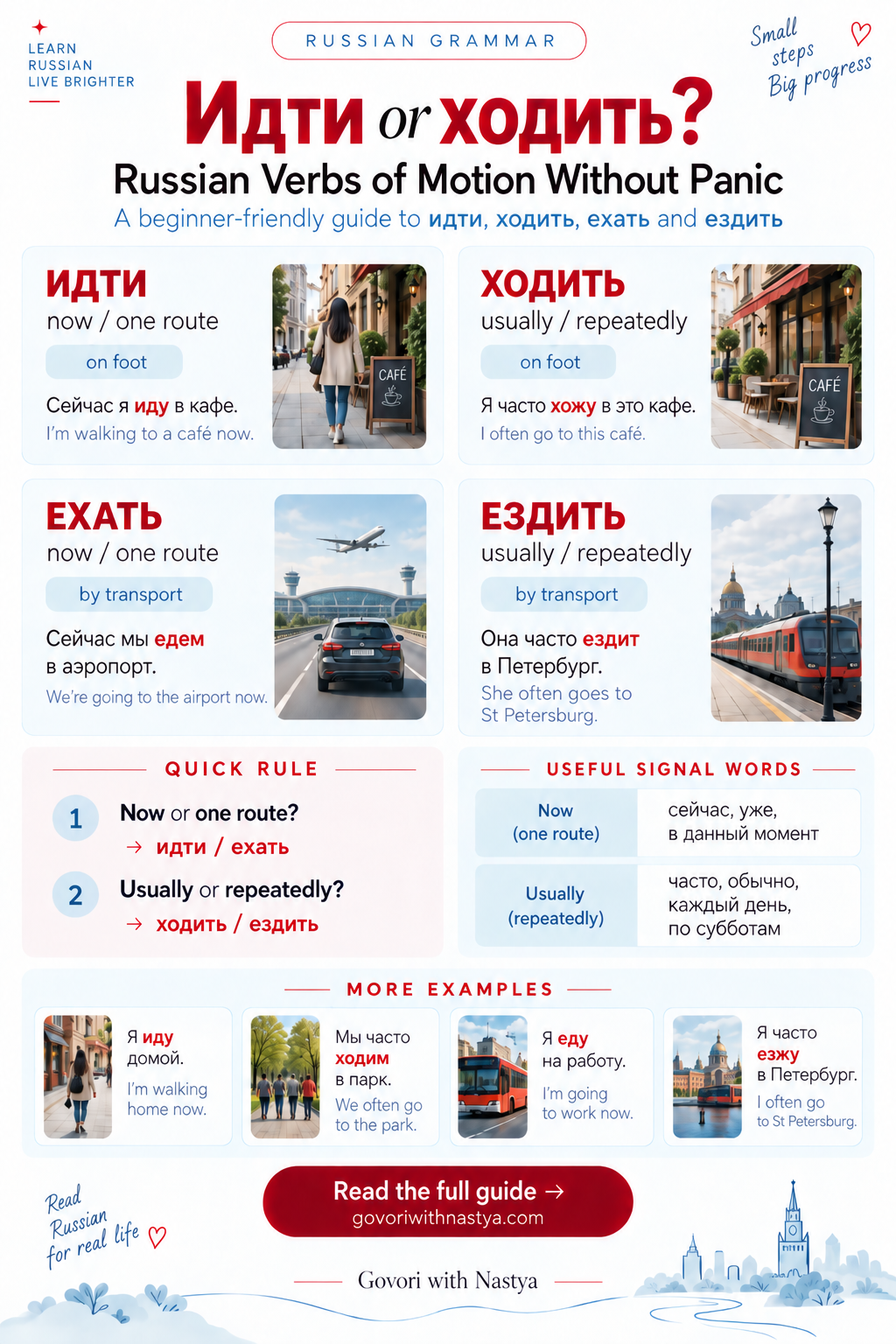
Save the verbs of motion visual guide
Keep the difference between идти, ходить, ехать and ездить in one visual reminder.
What to learn next
Continue with this closely related topic.

In a lesson, we can practise routes you actually use: home, work, university, transport, travel and everyday plans.