The player window could not open. Open the music player in a tab.
Perfective vs imperfective Russian verbs without panic
Why does Russian have both делать and сделать, читать and прочитать, писать and написать? The difference is not simply “unfinished” versus “finished”. Russian verb aspect shows how you look at the action: as a process, repetition or fact — or as one action with a boundary and result.
Несовершенный вид · Imperfective
Совершенный вид · Perfective
Two verbs, one action — different viewpoint
English usually uses one basic verb where Russian often gives you two related verbs. Compare:
A useful first question is not “Was the action physically finished?” but “What am I focusing on?” The process, repetition or fact of the action? Or one complete action seen as a whole?
The core contrast: process or boundary?
The two aspects are easiest to understand as two camera settings.
What was happening? Я читал.
What happens regularly? Я часто читаю.
Did this activity happen at all? Ты читал эту книгу?
Was one action completed as a whole? Я прочитал книгу.
Process
несовершенный видWhat was happening?Я готовил ужин.
I was cooking dinner.
Repetition
несовершенный видWhat happens regularly?Я готовлю каждый день.
I cook every day.
Result
совершенный видWhat was achieved?Я приготовил ужин.
Dinner is ready.
Learn verbs in aspect pairs
For beginners, it is much more useful to learn a verb together with its common aspect partner than to memorise long lists of prefixes.
| Imperfective | Perfective | Basic meaning |
|---|---|---|
делать | сделать | to do / make |
читать | прочитать | to read |
писать | написать | to write |
покупать | купить | to buy |
готовить | приготовить | to prepare / cook |
открывать | открыть | to open |
решать | решить | to solve / decide |
Important: prefixes are useful, but they are not a mechanical “perfective button”. A prefix can also change the meaning of a verb. Learn common aspect pairs as vocabulary.
In the past: what happened or what was achieved?
Both aspects have past forms. The difference is the focus.
In the future: буду читать vs прочитаю
This is one of the clearest structural differences between the two aspects.
I will be reading / I will read as an activity.
I will read the article and complete it.
Я буду писать отчёт вечером focuses on the activity.Я напишу отчёт вечером presents the report as a completed future result.
A crucial nuance: “completed” is not the whole rule
An imperfective verb can describe an action that really did happen and may even have been completed. The speaker may simply be asking about the experience or fact, not the endpoint.
Time words can help — but they are clues, not rules
Certain words often appear with one aspect because of the meaning they create. Use them as signals, not as automatic grammar formulas.
Often imperfective
repetition / habitкаждый день · часто · обычно · всегдаЯ обычно читаю перед сном.
Often imperfective
process / durationдолго · весь вечер · два часаЯ два часа писал отчёт.
Often perfective
one completed eventнаконец · вдруг · сразуЯ наконец написал отчёт.
Do not choose aspect from one adverb alone. First understand the situation: repetition, process, experience or a bounded result.
A simple method: ask four questions
When you hesitate between two aspects, move through these questions in order.
If it is a habit or repeated action, start with imperfective.
If you are inside the process, imperfective is usually the natural choice.
If the question is whether the activity happened at all, imperfective is common.
If one whole action reaches a boundary or result, consider perfective.
Mini trainer: choose the viewpoint
First reveal the logic, then choose the verb that fits the sentence.
Tap a card to see why the speaker chooses this aspect.
Choose the form that matches the situation.
Common beginner mistakes
Imperfective can describe an action that really happened, including an experience such as Ты читал эту книгу?
Use imperfective when the process, repetition or fact of the activity is what matters.
Perfective is an aspect. It has a past form such as сделал and a future form such as сделаю.
Ask first how the action is presented, then look at whether it is past or future.
A prefix can create a perfective verb, but it can also add a new meaning.
Keep pairs such as писать — написать and покупать — купить together.
Words such as часто and наконец can point you in a useful direction, but they do not choose the aspect by themselves.
Decide whether the situation is about repetition, process, experience or one bounded result.
What to remember
Perfective and imperfective describe how an action is presented; tense places it in time.
It is common for process, repetition and the fact or experience of an action.
Use it when the endpoint or achieved result is central to what you mean.
Буду читать presents an activity; прочитаю presents a future completed whole.
Pairs such as писать — написать are more useful than treating a prefix as an automatic rule.
Visual guide
A visual reminder of the main idea: imperfective for process or repetition, perfective for a completed whole, plus common verb pairs.
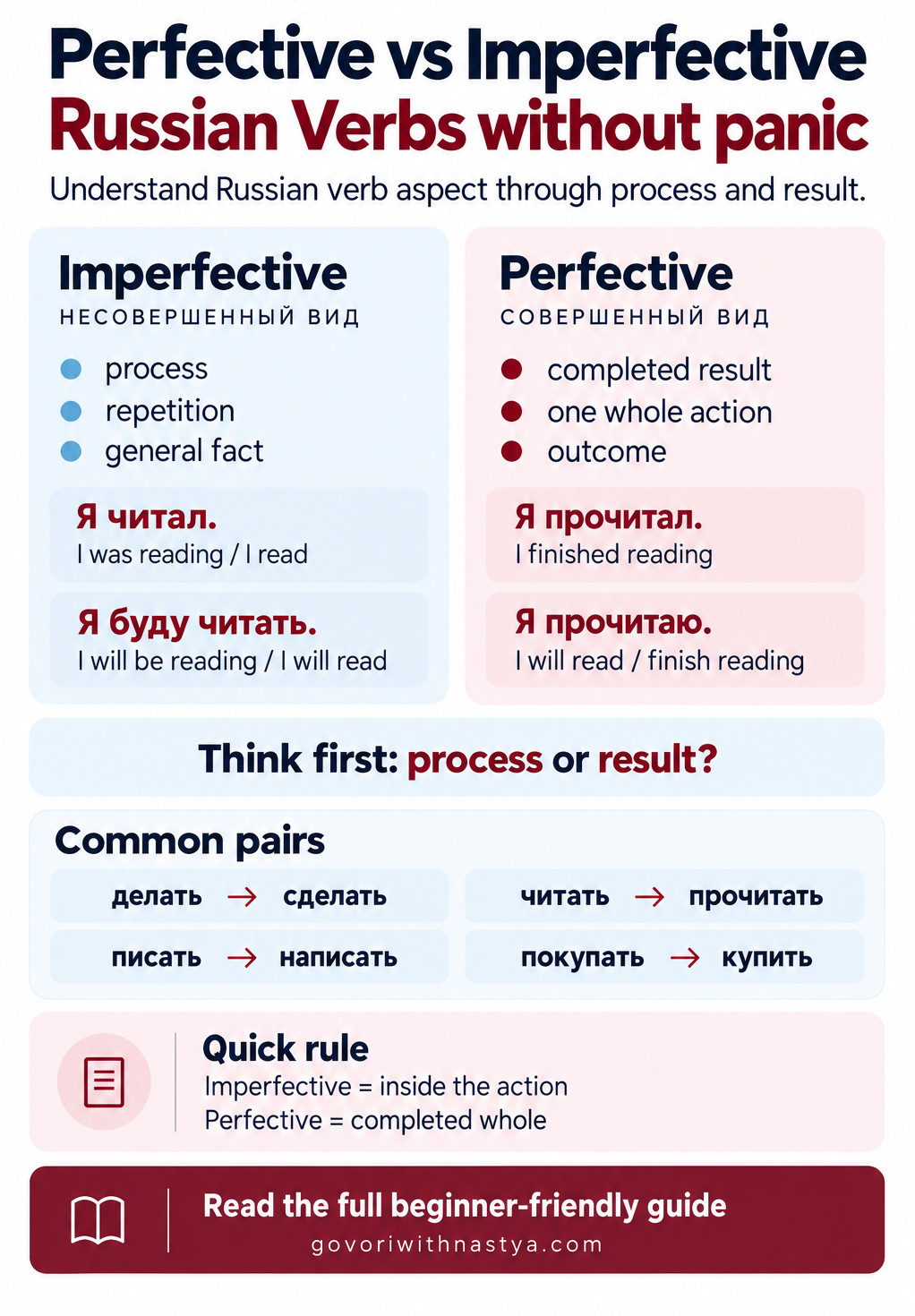
Perfective vs imperfective without panic
Save this visual guide as a quick reference for Russian verb aspect. Open the pin on Pinterest and save it to your Russian-learning board.
What to learn next
Continue with one of these closely related topics.

Book a free 30-minute trial. We can practise choosing between perfective and imperfective verbs in situations you actually need in Russian.